Wednesday, August 18, 2010

Lunchtime Lecture


I have just given the last in our series of lunchtime talks to accompany the Stanley Lewis exhibition on Augustus John, thank you to everyone who came; I hope you all enjoyed it. For those of you who missed it you can read it here.
The picture on the right is of Augustus's wife Ida Nettleship from the Cecil Higgins collection.

That’s it for art related talks until Toulouse-Lautrec in January but there are lots of fascinating R101 Airship talks coming up which we will keep you posted on.

VP

Picture of the Week No.31 - Jankel Adler


KP is off on holiday for a couple of weeks so GH and I are going to take it in turns to choose a picture of the week. This week it’s my pick and as I don’t regularly do it I am having trouble choosing. I try not to play favourites with the collection but if you pushed me I would have to say Edward Bawden, Dora Carrington, John Piper or Paul Nash, hence there is usually a work by one of them in our exhibitions. However I am very fickle so in my ten years here I have changed my mind regularly. Last week I was waxing lyrical over a Samuel Palmer, and this week I have been looking at our Augustus’s Johns with renewed interest.

I tend to like a picture because it’s beautiful or how it makes me feel, but some of my favourites are my favourites because I am so familiar with them. Such as Dora Carrington’s ‘Lytton Stratchey’, which a copy of hung on my bedroom wall for about ten years and which is the first picture I visit when ever I go to the National Portrait Gallery, or Howard Hodgkin’s ‘After Degas’ because it reminds me of the Hayward exhibition my mum took me to in the nineties which made me think working in an art gallery would be great.

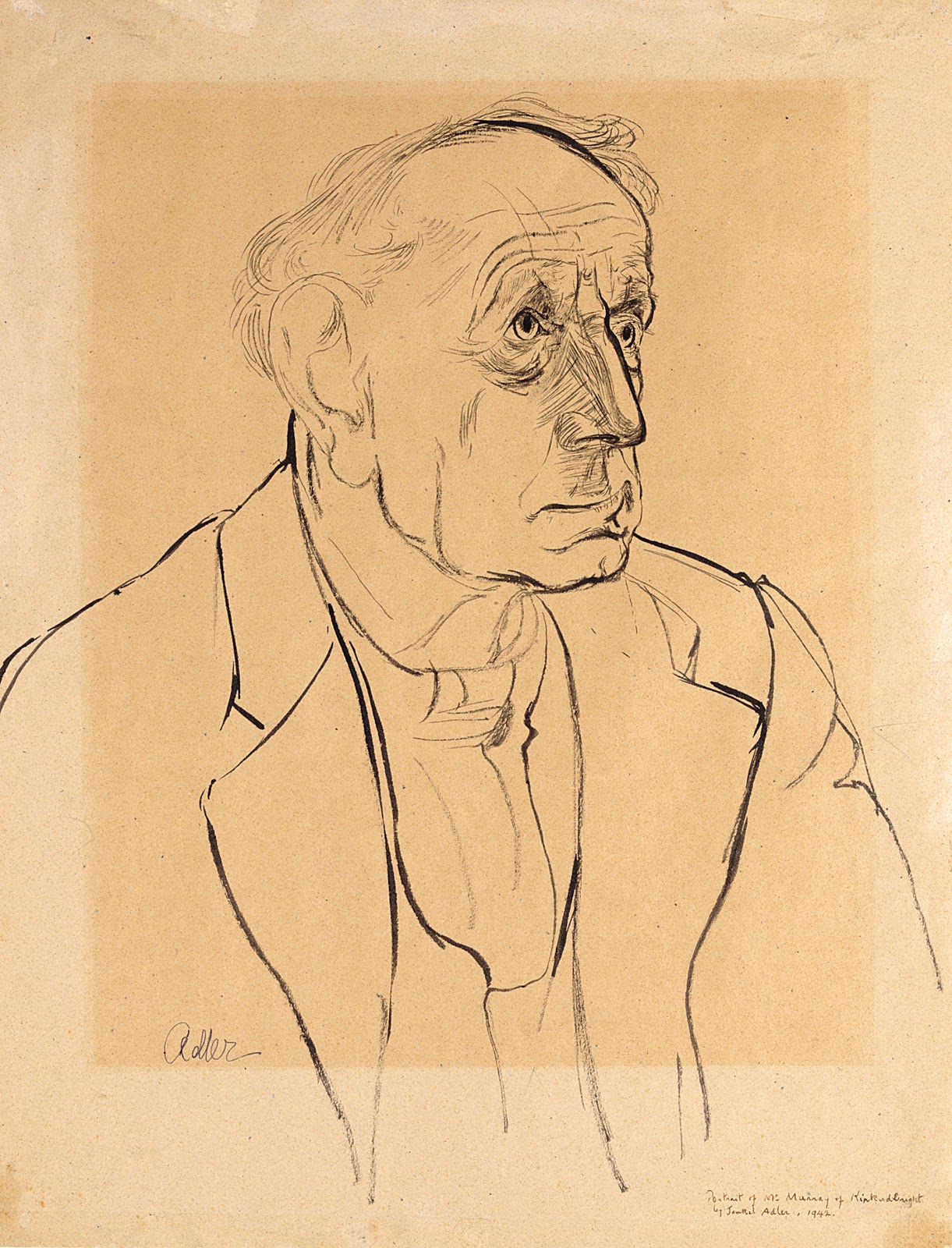
So my choice this week is Portrait of Mr Murray by Jankel Adler, for two reasons firstly it is a beautiful study, the lines on his eyes draw me in but secondly it reminds me of Kirkcudbright where I spent all my childhood holidays. Adler spent about six months in Kirkcudbright after he was invalided out of the army in 1941, like St Ives, Kirkcudbright was a popular place amongst artists including Jessie M King and E A Hornel who on being asked why Kirkcudbright attracted such talent said "Well, it's a fine old town and not too big, but big enough to keep you from vegetating." Kirkcudbright was certainly more than that, with unspoilt views, the sea only a moment away and the beautiful architecture, the small town was the perfect place for Adler to recuperate.
VP

JANKEL ADLER
(1895-1949)
Portrait of Mr. Murray
1942

ink on paper, 51 ´ 43.8 cm
inscribed: Adler
Portrait drawing of Mr.Murray of Kirkudbright by Jankel Adler 1942
P.374

Adler was born in Poland and studied art in Düsseldorf before being conscripted into the Russian army in the 1914-18 war. He went to Germany after the war where he lectured at the Akademie der Kunst, Düsseldorf, until his work was declared ‘degenerate’ by the Nazis. He moved to France where he worked with S. W. Hayter (1901-1988) at the Atelier 17. When he enlisted in the Polish Free Army during the Second World War, he was sent to Scotland (where he drew this portrait) before settling in London. His images have been described as being ‘expressive of a melancholy acceptance of fate’, of which the sitter here is a striking example.

Kircudbright is in Dumfriesshire but the local library has no trace of Mr Murray.
EJ/CB

Wednesday, August 11, 2010

Picture of the Week No.30 J.M.W. Turner

All of us here at the Art Gallery and Museum have been enjoying the BBC's Sherlock and are very pleased to hear there'll be more episodes. The first series ended on a ciff hanger ending, but one of the most dramatic moments in the original books was Sherlock falling, apparently to his death from the Reichenbach Falls in the Swiss Alps. Sir Arthur Conan Doyle wasn't the only person to be so creatively inspired; 90 years earlier JMW Turner had travelled there and produced one of his finest watercolours. In 1954 that epic painting was bought for the Cecil Higgins Collection. It remains one of the stand-out works in the collection and was recently in the Turner exhibiton that toured the US, finishing in the Metropolitan Museum of Art, New York. Sherlock Holmes, was brought back to life by Coyle Doyle in The Adventure of the Empty House after his dealy encounter with Moriaty by the great waterfall. How will the 21st version survive his similar situation? KP


JOSEPH MALLORD WILLIAM TURNER, R.A. (1775-1851)
The Great Falls of the Reichenbach, 1804
Entry from the Watercolour Catalogue:
Accesion No.: P.98
watercolour on paper, 102.2 ´ 68.9 cm
inscribed: J M W Turner R A 1804


Turner was born on 23 April 1775, the son of William Turner, a barber in Covent Garden. After the death of his sister, and 'in consequence of illness', he was moved to Brentford, living with his uncle, where he attended Brentford Free School as a day boy. His earliest known work is a copy of an engraving of Friar Bacon’s Study and Folly Bridge, Oxford (Oxford Almanack, 1780), made when he was twelve; it was at this time that he produced many sketches of churches, abbeys and city streets. A friend remembered Turner declaring that 'if he could begin life again, he would rather be an architect than a painter'.

Entering the R.A. Schools in 1789, his training is remembered by Edward Dayes who said 'The way he acquired his professional powers was by borrowing, where he could, a drawing or picture to copy from; or by making a sketch of any one in the Exhibition early in the morning, and finishing it at home. By such practices... the fine taste and colour his drawings possess are scarcely to be found in any other'.

The Great Falls of the Reichenbach was first shown at Turner’s own gallery held on the first floor of what was 64 Harley Street. Turner had conceived the idea of his own gallery due to uncertainty over the future of the Royal Academy in late 1803, with rumours abounding that Turner would not be showing at the the R.A. in 1804. Sir George Beaumont (who saw the Turner exhibition) complained of 'the strong skies and parts not corresponding with them'.

The Great Falls is a superb watercolour, made soon after Turner’s first visit to Switzerland in 1802, and is based on a sketch (Wilton no.361) now in the National Gallery of Ireland, Dublin. The view is taken from the valley of Hasli above Meiringen with Great Scheidegg beyond and shows Turner tackling a 'Sublime' subject with enormous confidence. Turner’s pride in the work is shown by the fact that it was again exhibited at the R.A. in 1815.
EJ/JM


PROVENANCE Bought from Turner by Walter Fawkes of Farnley Hall; Fawkes sale Christie’s 2 July 1937, no.37, bought in; Mrs F.M.C. Raymond; sale at Christie’s 13 October 1954 no.29; bought by Thos. Agnew & Sons Ltd, from whom purchased by Gallery, December 1954.
EXHIBITIONS: Turner’s Gallery, 1804; London, Royal Academy, 1815, no.292; London, Grosvenor Place (Fawkes’ London House), 1819, no.2; Watercolours from Farnley Hall, Leeds, Music Hall, 1839, no.23; Old Masters of the British School, London, Royal Academy, 1886, no.34; Old Masters of the British School, London, Royal Academy, 1906, no.205; Exhibition of British Art, London, Royal Academy, 1934, no.708; 68th Annual Exhibition of Watercolours, London, Thos. Agnew & Sons Ltd, 1941, no.36; L’Aquarelle Anglaise, Geneva, Zurich, 1955-56, no.117; The Romantic Movement, London, Tate Gallery, 1959, no.440; Primitives to Picasso, London, Royal Academy, 1962, no.380; Watercolours and Drawings from the Cecil Higgins Art Gallery, Bedford, London, Thos. Agnew & Sons Ltd, 1962, no. 61; Royal Academy Bi-centenary Exhibition, London, 1968 –9, no.203; La Peinture Romantique Anglaise et les Préraphaélites, Paris, Petit Palais, 1972, no.284; Turner, Paris, Le Grand Palais, 1984, no.100, William Wordsworth and the Age of Romanticism, Chicago, The Chicago Historical Society, 1988, no.292; The Great Age of British Watercolours 1750-1880, London, Royal Academy of Art and Washington, National Gallery of Art, 1993, no.284; Le Cattredali della Terra, Milan, Museo della Permanente, 2000, no.3; Turner The Great Watercolours, London, Royal Academy, 2000-1, no.18.
REFERENCES: Farnley Hall catalogue, 1850; F. Wedmore, Turner and Ruskin, 1900, vol.I, repr. facing p.100; C.F. Bell, The Exhibited Works of J.M.W. Turner, R.A., 1901, pp.51,170; Sir W. Armstrong, Turner, 1902, pp.130 & 272; A.J. Finberg, Turner’s Sketches and Drawings, 1910, p.39; ibid. Turner’s Watercolours at Farnley Hall, 1912, pp.1-2,21-2 pl.IX; A.J. Finberg, The Life of J.M.W. Turner R.A., 1939, pp.107, 219, 258, 466,477,479,503; A.P. Oppé, The Burlington Magazine, vol.78, April 1941, p.131; I. Williams, Early English Watercolours, 1952, pp.111,114; J. Gage, Turner: A Wonderful Range of Mind, 1987, p.42, fig.63; B. Dawson, Turner in the National Gallery of Ireland, 1988, pp.64-66; E. Shanes, Turner: The Masterworks, 1990, p.56, pl.57; D. Hill, Turner in the Alps, 1992, pp.119-125, repr. p.120. E. Shanes et al, Turner The Great Watercolours, 2000, p.86.

Thursday, August 5, 2010

Final flight of the R101

At the moment we're busy collating images and information on the airships R101 and R100, the development of the Imperial Airship programme, and the two vast sheds at Cardington, Bedfordshire, for the forthcoming exhibition on this fascinating subject. The exhibition is on from 2 October until 19 Decemeber 2010 in Bedford Gallery. I just came across this video which has been put together by Trevor Monk, on the final flight of R101 and thought it would be great to share it, especially for those unfamiliar with the tragic story of the largest airship ever built.

For lots more in-depth information on R101 and airships go to http://www.airshipsonline.com website of the Airship Heritage Trust. You can find them too on facebook at the R101 airship group http://www.facebook.com/home.php?#/gr... and finally there is a 'We Love the Cardington Sheds' group on facebook at http://www.facebook.com/home.php?#/gr...

Tuesday, August 3, 2010

Collection Focus

Dora Carrington (1893-1932)
In the past few years the gallery has been able to acquire a number of fine works by the artist Dora Carrington. Carrington grew up in Bedford, attending Bedford High School, before going to the Slade and becoming part of one of the most interesting art scenes in this country in the 20th century. The Cecil Higgins Collection, therefore, is an ideal place for her work to be, alongside many of her contempories.
This week we have unveiled our latest acquisiton, Carrington's 1911 study of Bedford Market, and it seemed the ideal moment to reflect on the collection that has grown since 2004. KP
Biography
Dora Carrington (1893-1932) was one of a group of young artists that included Paul Nash, Stanley Spencer, Mark Gertler and CRW Nevinson, who attended the Slade at the beginning of the 20th century. Referred to by their tutor as the Slade’s ‘last crisis of brilliance’, they emerged at a time of great change in the British art world, caused in part by Roger Fry’s Post Impressionism exhibition in 1910. Although Carrington admired the work of Cezanne and Matisse, unlike the majority of her contemporaries, she represented figures and landscapes as she saw them, refusing to respond to changing artistic movements. This decision led John Rothenstein to describe her as ‘the most neglected serious painter of her time’.

Carrington’s work is inherently autobiographical; she painted places where she lived and people she loved. The subject of her most famous portrait is the author Lytton Strachey, with whom she lived from 1917 until his death in 1932, followed two months later by her own suicide. Much is known about Carrington’s life as she was a prolific letter writer, corresponding with the artistic and literary greats of the time, including Gerald Brenan, Mark Gertler, Paul Nash, Rosamund Lehmann and fellow Bloomsbury group member Virginia Woolf. Carrington is also depicted in fiction; she is Mary Bracegirdle in Aldous Huxley’s ‘Crome Yellow’ and Minette Darrington in D H Lawrence’s ‘Women in Love’. VP

Bedford Market, 1911.
Pencil, ink, and watercolour on paper 43.1 x 67.5cm
Accession No.: P.1005
Bedford Market is a rare depiction of Carrington’s early life in Bedford. Although she made many drawings of her father and brothers, there is no known other work which takes as its subject the town of Bedford. The Carrington family moved to Bedford in 1903 when Dora was ten. At that time, a large part of the town’s population was made up of the families of retired soldiers or colonial administrators. Like many of these families, the Carrington’s chose Bedford because of the town’s good but inexpensive schools, in which Dora and her four siblings were educated, Dora attending Bedford High School for Girls until she entered the Slade School of Art in 1910.

Carrington drew Bedford Market on a rare trip home from the Slade a year after entering the school. She found the contrast between the freedoms of London and the Edwardian society of the small market town of Bedford unbearable. Her brother Noel wrote that, though Bedford was only fifty miles from London by train, it ‘might have been almost a thousand for all the cultural influence then exercised on it by the metropolis’.

In her first year at the Slade, the teaching emphasis would have been on draughtsmanship and Carrington produced two distinct styles of drawings; an academic one in which form and modelling were predominant, as seen in her life drawings, and the more linear style seen in Bedford Market and other works such as Cockney Picnic (c.1911). Both of these styles show her scrupulous attention for detail and eye for arrangement.

The view point of Bedford Market is from Bedford High Street looking onto St Paul’s Square, where the market is still held today. The names of Bedford traders on the market stalls and shops can be clearly seen, as can the gravestones from the Church in the far left corner. VP
PROVENANCE: Anthony d'Offay; Private Collection; Bonhams, from whom purchased by Gallery in 2010
EXHIBITIONS: London, Upper Grosvenor Galleries, Carrington, A Retrospective Exhibition, 6 November - 28 November 1970, London; Anthony d'Offay, Carrington and her Friends, 25 June - 26 July, 1980; London, The Barbican Art Galley, Carrington - The Exhibition, 21 September - 10 December 1995.

REFERENCES: Noel Carrington, Carrington, Paintings, Drawings and Decorations, Thames and Hudson, 1980, p.16 (ill. b&w); Gretchen Gerzina, Carrington, A Life of Dora Carrington 1893-1932, Pimlico, 1995, p19; Jane Hill, The Art of Dora Carrington, The Herbert Press, London, 1994 p.14 (ill. b&w)

Purchased with the assistance of The National Art Collections Fund and the V&A Purchase Grant Fund

Spanish Boy, c.1924.
Oil on canvas, 63.5 x 50.8cm.

Accession No.: P.993

Spanish Boy was probably painted in Yegen, Spain at the home of Gerald Brenan, with whom Carrington was having an affair. Brenan regularly held musical evenings and it was at one such night that Carrington wrote of witnessing a beautiful young man singing: ‘Then a young man with a face so beautiful that it is imprinted on my memory so that I could draw every feature…His hat was tilted back from his face and showed his rather bulging forehead with a shining highlight on it. He had a most amazing mouth a short upper lip with a slight curl... Suddenly the profile altered, the eyes glittered wildly the mouth opened, the forehead puckered. A strange wailing song came out and his whole body shook and the face became contorted with sadness and passion. It was a most moving song.’ VP

PROVENANCE: Purchased from the artists family Purchased with the assistance of The National Art Collections Fund and the V&A Purchase Grant Fund.
Mrs Box, 1919.
Oil on canvas, 91.4 x 76.2cm.
Accession No.: P.936
Carrington first met Mrs Box whilst on holiday with Lytton in Cornwall in September 1917, painting her as a traditional farmer’s wife in an old-fashioned bonnet. VP
PROVENANCE: Purchased from the artists family.
Purchased with the assistance of The Art Fund and the V&A Purchase Grant Fund
Teddy Carrington, c.1915.
Pencil on brown paper 44.6 x 30.3cm
Accession No.: P.1003
Carrington idolised her brother Edward, known as Teddy and his death at the Somme in 1916 greatly affected her. In 1923 she described him in a letter to Gerald Brenan as having ‘had very dark olive skin, almost black eyes and pitch black hair - as a little girl I always thought there was a mysterious secret attached to him and that he wasn’t really my Father’s son because we were all fair’. VP

PROVENANCE: Purchased from the artists family

Noel Carrington, c.1912.
Pencil on paper 31.5 x 39.9cm
Accession No.: P.1002

This work, produced when she was at the Slade, is an excellent example of the academic style of drawing that she had developed there. The sitter is her brother Noel whom she often persuaded to sit for her on visits home to Bedford. VP

Fragment of a letter to Margaret Burr, about 1910

Accesion No.: AM15

This fragment is all that remains of a letter to a friend of Carrington's named Margaret Burr, referred to here as Marmie, who had attended Bedford High School at the same time as Carrington. The illustration of a bee in the top left corner makes reference to Margaret’s nickname.

Carrington was an avid letter writer throughout her life, but very few letters survive from her time at the Slade. This letter was written whilst she was staying at Byng Place, London a respectable hostel for students and makes reference to a visit from her sister Lottie visiting her for tea. VP

Monday, August 2, 2010

Picture of the week No.29 - John Singer Sargent

John Singer Sargent is famed for his glamourous society portraits, such as Madame 'X' at the Metroploitan Museum of Art, New York. The Royal Academy is currently showing another side to the artist withthe Sargent and the Sea exhibition and it is Sargent's later interest away from the figure that we look at for this week's Picture of the Week. 'A Venetian Canal' is a close up and more intimate scene than the 'vedutas' he claimed not be able to paint, a squoted in the catalogue entry below. Veduta is the Italian word for view and refers here to highly detailed landscape paintings or 'vedutas' that became popular in the 17th and 18th centuries. KP


JOHN SINGER SARGENT (1856-1925)A Venetian Canal (date unknown)

Watercolour Catalogue Entry:
Accession number: P.412
watercolour and pencil on paper, 24.3 ´ 34.5 cm
It is not easy to date Sargent’s Venetian watercolours which, as here, are very freely painted with a loaded brush. It seems that he began painting them on his second visit to the city in 1880 and on many subsequent visits, which became part of his annual break from portrait painting from the late 1890s onwards. He described his choice of subjects there as 'I can paint objects, I can’t paint vedutas'.

Sargent was born in Florence of American parents; studying in Paris under Carolus-Duran (1837-1917), he remained in France until 1884 before coming to England where he became the most fashionable portrait painter since Sir Thomas Lawrence (1769-1830).

Superficiality was always his enemy but occurred less in his landscapes to which he turned almost exclusively after 1910. Pissarro summed him up as 'an adroit performer'.
EJ

PROVENANCE: Mrs F. Ormond; by descent to her daughter Mrs Hugo Pitman (the artist’s niece); Thos. Agnew & Sons Ltd, from whom purchased by Gallery, January 1962.
EXHIBITIONS: Watercolours and Drawings from The Cecil Higgins Art Gallery, Bedford, London, Thos. Agnew & Sons Ltd, 1962, no.82.

Tuesday, July 27, 2010

What's on the blog?

What's on the blog? Have a look at this 'wordle' and it'll give you a pretty good idea of the sort of things we talk about from week to week. Clicking on the image below will take you through to a much larger version.

Wordle: Cecil Higgins Art Gallery & Bedford Museum blog content

© 2009 Jonathan Feinberg Terms of Use subscribe

Monday, July 26, 2010

Picture of the Week No.28 - Henri Gaudier-Brzeska

Henri Gaudier-Brzeska was one of the most talented artist's working in London before the first world war and was part of the Vorticist circle that included Jacob Epstein, Percy Wyndham Lewis and Ezra Pound an was a founding member of the London Group of artists. Born in France, he eventually left for England in 1911 to with Sophie Brzeska, a Polish woman twenty years his senior whom he had met in a library and whose name he adopted, in order to become an artist. He never took any formal training but his work was of the highest quality.
Gaudier-Brzeska's sculpture was rough-hewn and distinct, originally taking inspiration from Rodin then from African carvings and other ethnic sculpture. His draughtsmanship was marked by his exquisite use of line and was informed by Chinese calligraphy that he had been exposed to by Ezra Pound. This week's picture is a good example of how much control over line he had, with a fine portrait of Mrs. Alfred Womack.

He joined the French Army and was killed in the trenches in June 1915. His achievement has been overshadowed by his colourful life, as featured in Ken Russell’s film Savage Messiah. KP

HENRI GAUDIER-BRZESKA (1891-1915)
Mrs. Alfred Wolmark, 1912

Entry from the Watercolour Catalogue:pencil on paper, 34.5 ´ 24.4 cm
inscribed: Mrs Wolmark, Brzeska drawing 1912

Accession Number: P.178

The sitter was the wife of Alfred Wolmark (1877-1961), a painter, designer of pottery and stained glass who was a friend of the artist. He encouraged the young artist and often sat for him. Gaudier-Brzeska returned the complement.

This simplified, linear drawing is typical of Gaudier-Brzeska’s style. It dates from the same year as a painting of Mrs Wolmark exhibited at the Leicester Galleries in 1958.
EJ/CB

PROVENANCE: Wolmark Collection; Lord’s Art Gallery, from whom purchased by Gallery, December 1957.
EXHIBITIONS: Portrait Paintings and Drawings, Rye, Rye Art Gallery, 1967; The English Tradition: an exhibition of watercolours from two private collections, Bedford, Cecil Higgins Art Gallery, 1972, no.39.
REFERENCES: R. Cole, Gaudier-Brzeska: Artist and Myth, 1995, p.65.

Thursday, July 22, 2010

Picture of the Week No.27 - Sickert

Picture of the week has had a few weeks off recently while several of the small team here at the Art Gallery and Museum have a well deserved week or two off, but now it's back and we're looking this week at an artist represented in the collection by 3 prints, a watercolour and 4 drawings: Walter Richard Sickert. Sickert is a big favourite of mine since I was first introduced to his work by my late art history lecturer John Rimmer, who sadly passed away a couple weeks ago.

The picture that first really grabbed me was the Tate's Minnie Cunningham at the Old Bedford with its glowing red and scumbled browns, and the music hall was a prominent theme for Sickert during the late 19th century. This week's picture is set in the same venue in Camden Town but features a diffenent act. Little Dot Hetherington at the Bedford Music Hall, c.1894 is a lithograph after a painting of the same name. The performer in her white dress, illuminated by the stage lights. points up to the gallery in reference to the title of the song she is singing -‘The Boy I Love Is Up In The Gallery, later made famous by another music hall artiste, Marie Lloyd.The seats at the bottom of the compostion and the heads of the audience place the viewer very much within the audience and makes the subject not just the performer on stage but also the whole event and experience of seeing these performances and of course the setting itself. There is also a version painted on a fan in the Fan Museum that can be viewed here. KP


Walter Richard SICKERT (1860-1942)Little Dot Hetherington at the Bedford Music Hall, c.1894

Entry from the Print Catalogue:Accession Number: P.559
lithograph, 28 × 26.2 cm (image)
inscribed: Sickert inv et lith in plate
To Max WS in ink
PROVENANCE: Max Beerbohm – see inscription; Christopher Mendez & Co, from whom purchased by Gallery, May 1967.
REFERENCES: R. Bromberg, Walter Sickert Prints, 2000, no.118, pp.100-1.
NOTES: Not editioned and few impressions printed.

The work shows Dot Hetherington singing ‘The Boy I Love Is Up In The Gallery at the Bedford Palace of Varieties, High Street, Camden Town, named after the Duke of Bedford, on whose estate the hall was built. The Bedford Music Hall was first opened in 1861 and re-built in 1899 following a fire. It was closed in 1959 and demolished in 1969. The lithograph was based on the oil painting of this subject in the Yale Center for British Art, New Haven (B.179.12.819). Sickert drew the design onto the lithographic stone and scratched out the highlights using a needle. This can be seen to best effect on the lower horizontal bar.

The artist gave this work to Sir Max Beerbohm (1872-1956), writer and caricaturist.
CB

Monday, July 5, 2010

We've just discovered some fantastic pictures of Edward Bawden's house and studio taken shortly after he died in 1989. Follow this link: http://real-photographs.co.uk/?p=550

Edward Bawden donated over 3000 items to the Art Gallery & Museum and as part of our redevelopment plans we will have a dedicated Edward Bawden Gallery.