Thursday, August 18, 2011

Out and About - A new blog from our Learning & Access Team

Hi everyone,

since the Art Gallery & Museum has been closed for redevelopment our Learning & Access team have been out and about, working in partnership with lots of different groups. You can keep up to date with all of their news over at Out & About. The first post involves some amazing 40's glamour courtesy of Sarah Dunn's Doo-Wop Dos.


Read all about it here


Tuesday, August 9, 2011

Building work starts

Its been a busy few days at Cecil Higgins Art Gallery & Bedford Museum. Builders have moved in and begun work at the site. We're really excited that this dramatic phase of the redevelopment has begun. We'll be keeping you all up to date with all of the news about the redevelopment here on the main blog - with some more in depth news over at our new Redevelopment Blog.

The beginning of the building work represents a big step towards realising the vision for a new Art Gallery & Museum. Dave Hodgson, Mayor of Bedford said “With the work now under way, we look forward to its completion and to the reopening of the Cecil Higgins Art Gallery & Bedford Museum for the whole community to enjoy.”
Work beginning at the site.
The building works are scheduled to last for 11 months, followed by 6 months’ refitting of the galleries.
Once the works have been finalised, the new galleries will display objects in the collection that have never before been on show, as well as returning some old favourites to pride of place. Among the new displays, nationally significant collections of work by the Victorian architect-designer William Burges and the 20th century designer-printmaker Edward Bawden will be housed in dedicated galleries. New exhibition space will also allow the hosting of touring exhibitions from national museums, as well as displays from the Art Gallery & Museum’s outstanding watercolour and print collections.


The Zodiac Settle by William Burges will be on display in the William Burges Gallery.


There will be lots more space to display the Edward Bawden Archive, including this illuminated manuscript 'A general guide to the Royal Botanic Gardens, Kew, Spring and Easter 1923'


This redevelopment has been made possible by £3.2 million funding from Bedford Borough Council, as well as a grant of £959,000 from the Heritage Lottery Fund, £100,000 from the Trustees of the Cecil Higgins Art Gallery, £500,000 from the Wixamtree Trust, £500,000 from The Bedford Charity, £350,000 from the Monument Trust, and £200,000 from Charles Wells Ltd, in addition to funding from a number of other sources.


Monday, July 11, 2011

Inauguration Day

On this day, 11th July, 1888, some of Bedford's most iconic features were unveiled to the town. The Suspension Bridge, Bedford Park and Mill Meadows (or Duck Mill recreation ground) were all opened, and the foundation stones for the Fire Station were laid. The town's Mayor, Joshua Hawkins, accompanied the Marquess of Tavistock, along with Samuel Whitbread who laid one of the two foundation stones for the fire station, still visible on Mill Street, on what came to be known as Inauguration Day.


The suspension bridge was designed by John J. Webster and had been paid for by public subscriptions. The river had for centuries been a vital commercial highway with much of the goods coming in and out of the town that way. With the arrival of the railways the river could instead be a focus for leisure and recreation. The embankment was extended, Mill Meadows created as a public park, and the old slum cottages of Waterloo - opposite where the Embankment Hotel now stands - cleared and replaced by the Embankment Gardens.  Russell Park followed 10 years later when the 11th Duke of Bedford gave the land as a park to the people of Bedford.

Slum cottages, Waterloo - now the far more presentable Embankment Gardens.

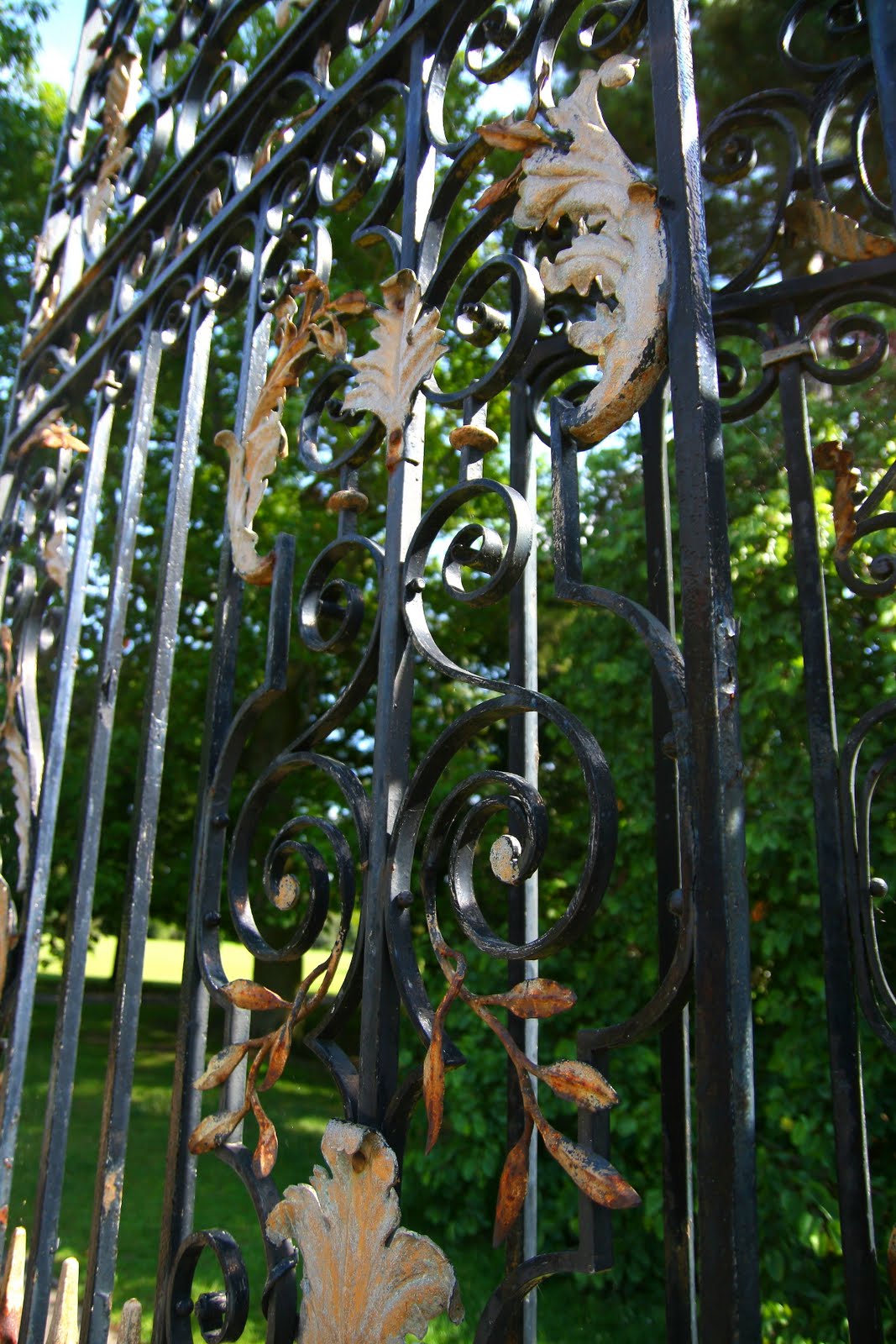
The hand-made iron gates by Messrs Bacchus and Ison, and their names engraved on the plaque on the entrance to Bedford park

 Bedford Park, along with De Parys Avenue, was laid out on land that had been owned by St. John's Hospital, which still stands on St. John's Street. The park was proposed in 1879 and made a public space by an act of Parliament in 1881, ensuring the demolition of Bury Farm and a large house last occupied by a French noble, the Vicomte de Visme. The Bedford Park gates, which record the opening and complete the fine vista down De Parys, were hand made by Bacchus and Ison, their name visible at the bottom of the two plaques on the gate posts. The Duke of Bedford had given the gates to the Park and also had given the volunteer fire service a new steam fire-engine in 1887, and a new building to house it was commissioned. 

Gothic details by John
Usher above a High
Street fast food outlet

Former Fire Station, Mill Street

The fire station features the only public commemoration of Usher and Anthony Architects of which the principal architect John Usher designed such familiar Bedford buildings Holly Lodge, The Grove; Alexandra Cottages, Grove Place; Blunham Rectory; and Clapham Park. The striking gothic styled building on the High Street with coloured brick work, ogee windows and gun-dogs either side of a decorated gable is another Usher design, originally for H.Adkin, the gunsmith, now a Subway.
 

Friday, June 24, 2011

Your Paintings

A fantastic new resource has just been launched on the BBC’s website called Your Paintings that aspires to give access to every single oil painting in public collections. Its' certainly made a great start with more than 63000 records online so far!


The project came from the Public Catalogue Foundation, who have been going round county by county recording all the paintings in the institutions in each area in order to produce a book on those collections. They came to Bedfordshire thankfully before we had packed away all our collections and the glossy volume Oil Paintings in Public Ownership – Bedfordshire, Cambridgeshire & Northamptonshire came out earlier this year.

As well as all of the oil paintings in Cecil Higgins Art Gallery & Bedford Museum, the county is represented by paintings from Bedford Borough Council, the John Bunyan Museum, Moot Hall, Wrest Park, and the University of Bedfordshire, as well as many others.

The Your Paintings website lets you browse through the paintings, search by Gallery or Collection, or search by artist - where each painter is beautifully represented by a painted portrait. Clicking on an artist can lead you on to a wealth of information that includes not only the usual biography and selection of works but also slideshows and links to BBC content on the iPlayer such as the programmes The Culture Show and Making Masterpieces.


An area we particularly like (and can't wait to explore fully!) is the Tagger feature. This allows users of the site to tag content in the pictures so that the subjects or details in the pictures can be searched on. This could be a simple as the keywords 'portrait' or 'landscape' or could get far more specific pointing out details like 'bonnet' or 'oak tree', or art historical genres such as 'Impressionism' or 'Vorticism'.

The possibilties are endless! The site gives you the opportunity to bring together pictures from all over the country in your personally constructed themes. And soon users will be able to create their very own guided tours too. Curators, Education departments, art enthusiasts and visitors alike will find this a valuable tool. Most importantly it should help to give the public a sense of ownership of their national and local collections, and get out and visit their museums and galleries. KP


Monday, June 20, 2011

On this day - the siege of Bedford Castle

On the 20th June 1224 the siege of Bedford Castle began. Most people in Bedford are familiar with Castle mound and the story of the siege. However - dig a little deeper into the story and our knowledge usually becomes a little sketchy...

Who built the Castle? How long was it there for? Who beseiged it? Why?

Even after a little digging, I've found out lots about the Castle that I didn't already know.

Who Built the Castle? When? Why?
The earliest Castle was built by Ralf de Tallebosc soon after the Norman Conquest in 1066. A large part of the existing Saxon town was flattened to make way for the castle, which in its earliest days would have been made of wood. The Castle was built because the incoming Normans needed a place to overlook the newly conquered town, to defend themselves from the town (if need be), to defend themselves and the town from other attackers and they needed a stronghold from where they could retreat into the coutryside.


Gradually the castle was rebuilt in stone, so that by 1130 it had a “strong and unshakeable keep”. By this time it was in the hands of the de Beauchamp family, who held the Barony of Bedford.

Under siege

The castle actually suffered several attacks before the great siege of 1224. The first of these was around 1137, when it was captured by King Stephen. During a siege in 1153 Prince Henry, soon to be King Henry II arrived in Bedford, delivered heavy plundering and left the castle in flames. St Paul's Church suffered some damage although we don't know how extensive this was. There was another siege in 1215, when King John sent Faukes de Breaute to capture it, following a minor rebellion that arose when the King refused to abide by the terms of the Magna Carta.

The Villian - Faukes de Breaute
King John gave Faukes de Breaute the castle and barony to thank him for his efforts. Faukes set about fortifying the castle and it is said that he pulled down St Paul’s Church to use the stone. Through the early 1220s, from his impregnable base, Faukes gained a reputation as an oppressive landlord and was eventually fined £3,000 by the King’s justices based at Dunstable.

Angry at the fine, Faukes sent his brother William to capture the three justices (although two escaped) and take them to the castle. The King (Henry III by this time) was furious and ordered Faukes to release the captured judge – when he refused the King ordered an attack on the castle.

Faukes had left the defence of the castle to his brother William so was safely out of the way when the attack came.

The final siege

Matthew Paris, a monk at St Albans Abbey, chronicled the Siege of Bedford some years later. The chronicles say that the siege lasted for 8 weeks, during which time the walls of the castle were bombarded daily with large lumps of stone flung from siege engines. Miners were used to dig underneath the castle walls and it was this that eventually led its destruction: on the 14th August the final walls collapsed when the tunnels were lit on fire, and the Keep was taken.

There my have been over 2500 men involved in the siege, coming from as far away as Cumberland in the north and Dorset in the south. Around 200 of them were killed. Most of the men inside the castle were hanged, although it is said that 3 were spared to serve as Knights Templar in the Holy Land.

The fall of the castle would have been a severe loss to the town as it would have been the town's biggest employer and the focus of town life. In the years since the siege the castle mound has had several uses. From the late 14th Century the ruins were used as a rubbish dump and in the 18th Century the top of the mound was used as a bowling green.


If you fancy finding out more about the siege why not go along to The Siege ,

Wednesday, May 11, 2011

The Bedford High Street History Project

Hello all,

I've been working on some interesting projects recently, trying to find ways to get our collections out and about whilst our building is closed for redevelopment. A museum of course, is much more then a building, so we should be able to find plenty of ways for people to engage with collections, heritage and museumy things during the redevelopment.

The first of these is The Bedford High Street History Project -


Bedford High Street History Project was inspired by a BBC One series broadcast in the Autumn of 2010, Turn Back Time - The High Street. This showed how shops changed radically between the Victorian era and the 1970's. The programme makers also invited members of the public to investigate and record the history of shopping in their own locality. So with a great deal of help from Margaret Badley, a group of researchers* was set up to investigate the history of Bedford High Street.

This has been a great opportunity to pull together the reams of information about shops in our High Street which was scattered between Bedford Library, Bedfordshire and Luton Archives and Records Service (BLARS), Cecil Higgins Art Gallery & Bedford Museum and the Historic Environment Record (HER). All of these are open to the public for further research apart from the Art Gallery & Museum which is closed for redevelopment until late 2012.
The results of all of this research can be seen in an exhibition at Bedford Central Library, which runs from 16th - 28th May 2011.

You can also access some oral history interviews, photographs and view some artefacts from the Cecil Higgins Art Gallery & Bedford Museum Collections on a dedicated blog we have put together. If you happen to be walking along the High Street, have a look out for our QR Code posters. These should be up in Goldings, Harrison & Simmonds, The Skills Bank, Allders Opticians and Debenhams. So far there are only five stops on our QR Code tour, but we hope to add a few more in time..

If you would like to know more about what QR Codes are and how they work - have a look here.

*Stuart Antrobus, Terry Darlow, David Fowler, Sally Heard, Hilary McDonald, Cathy Moorhouse, Elizabeth Mortimer, Jennifer Salter and Barry Stephenson.

Tuesday, May 3, 2011

Cecil Higgins Art Gallery & Bedford Museum Group Pool

Waterloo RoadRoad ClosedThere was a band!little dogWills and KateGladstone Street
ladiesHigh Kicks (2)High Kicks (7)High Kicks (6)High Kicks (1)High Kicks (3)
High Kicks (4)High Kicks (5)High Kicks (8)_MG_7235_MG_7228_MG_7187
_MG_7216_MG_7302 - Version 2_MG_7299_MG_9999_MG_7295_MG_7280

We've been enjoying the photographs of street party celebrations in our Flickr Group Pool. If you have some great shots from street parties in Bedford, why not add them here?

Thursday, April 28, 2011

Royal Wedding Fever


Royal Wedding anticipation and excitement is at feverpitch with only 1 day left to go (although some folks in the office a just glad to get an extra day off!) To celebrate the forthcoming nuptials of William and Kate we've been having a look through our collections for images of Royal Weddings past. We found this lovely edition of the Radio Times in our Reminiscence boxes. It celebrates the 1947 wedding of Princess Elizabeth and Philip Mountbatten, Duke of Edinburgh.


And this lovely commemorative copy of the Radio Times celebrating the 1981 wedding of Charles, Prince of Wales and Lady Diana Spencer. As well as this amazing commemorative brick! There were only 100 of these made, so we are lucky to have one. I wonder if there will be any William and Kate bricks? We were looking for pictures of Royal Wedding themed streetparties and celebrations, however we have found very little of this in our collections. I did find this lovely pic of a 1977 Silver Jubilee Celebration on Wendover Drive on Bedford Central Library's website.


Are you there? Do you remember parties like these? I remember going to a street party on Kingsley Road, Bedford to celebrate Sarah Ferguson and Prince Andrew's wedding in 1986. It would be amazing to see any photographs of that party! So, if any of you have photographs of street parties celebrating Royal Weddings of the past we would love to see them! We would also love to see photographs of your celebrations for the coming weekend, alongside bunting, flags and marvelous memorabilia! You can send photos to our new Flickr Group Pool.
Get posting! And have a lovely long weekend!


Monday, March 28, 2011

Change is afoot.

This week we're going to be moving out of our offices, and into some temporary offices. It feels like a really big change, and for most of us it is the first really tangible step towards the redevelopment of the Art Gallery & Museum. Change is most definately afoot. The removal people arrive tomorrow.
Main office at Cecil Higgins Art Gallery

Boxes everywhere.

Staionery cupboard, now empty.


We're surrounded by boxes and empty shelves. And everytime you realise you need a calculator or a paperclip you find they have all been packed already. Luckily the kettle is still available! I'm sure anyone who has moved house recently will know this feeling.
There is a lot of sadness as we leave these old buildings behind. But we are also very excited about the progress we're making, and the fact that building work will be starting soon. I'll be sure to keep you all abrest of developments as the project continues! In the meantime, I've been struck by the volume of odds and ends left in the buildings. Museum folk are possibly not the best at throwing things away. Moving office has been a much needed, and possibly overdue prompt to clear out some of the clutter that has gathered over the years.
A giant key left on empty shelves.


A ladder and a fan ignore each other.

Lots of odd things

Watering can

Watering can with table lamp and giant vinyl clock!

There will be many more big changes to come, and we look forward to them with optimism, excitement and gusto.